

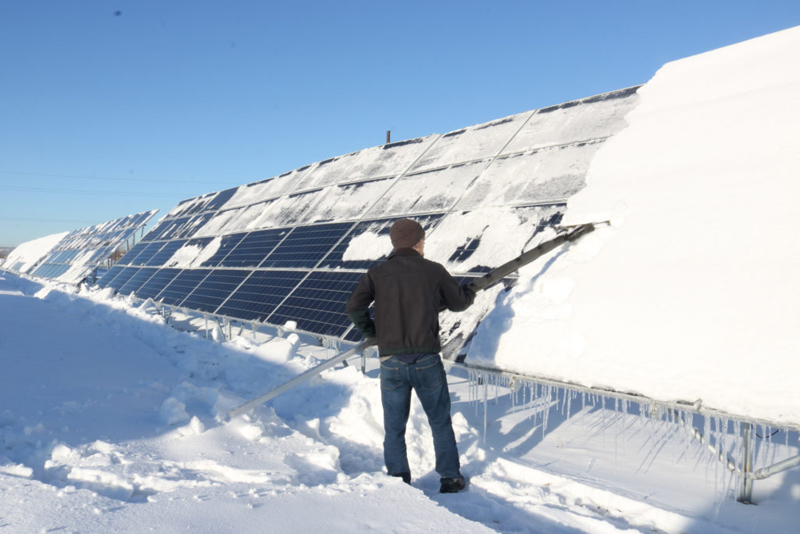
For solar projects in snow-prone areas, snow accumulation can lead to reduced power generation and the risk of hot spots, while heavy snow loads are a major cause of solar mounting system failure. The design integrates tilt angle and load-bearing capacity to balance self-cleaning capability, power generation, and structural safety.
I. Module Tilt Angle Design
In typical regions, the tilt angle is generally determined by the local latitude; however, this approach cannot be directly applied to areas prone to snow accumulation, where the primary consideration for tilt angle design is the system’s ability to shed snow naturally.
1. Minimum Tilt Angle: Based on experience, a tilt angle of ≥30° is recommended for mounting structures in areas with frequent snowfall. If the tilt angle is too small, snow tends to accumulate on the module surface, making it difficult to slide off naturally and resulting in long-term coverage of the panels; Increasing the tilt angle increases the gravitational component of the snow load, making it easier for snow to slide off.
2. Maximum Tilt Angle: It is not recommended to simply increase the tilt angle indiscriminately. An excessively steep tilt angle will, on the one hand, significantly increase the vertical height of the mounting structure and wind loads, leading to higher material costs; on the other hand, sliding snow will accumulate in large quantities beneath the array, potentially burying the rear rows of modules, while the mounting structure’s foundation will be subjected to lateral pressure from the accumulated snow.
Selection Guidelines:
- Light snow areas (snow load < 0.5 kN/m²): 30°–35°, balancing power generation and self-snow removal;
- Moderate to heavy snow areas (0.5–1.0 kN/m²): 35°–40°, prioritizing snow slide;
- Heavy snow regions (>1.0 kN/m²): 40°–45°, with increased spacing between array rows and columns.
Note: Wet snow and ice have strong adhesion; relying solely on the tilt angle will not achieve fully automatic snow removal.
II. Snow Load and Structural Design
Structural calculations should be performed based on the local 50-year return period snow load, with particular attention to adverse conditions such as uniform snow accumulation, localized snow drifts, and drifted snow; a snow load multiplier must be applied for leeward valley areas.
Combined structural analyses for snow load, dead load, and wind load must be performed for main beams, purlins, columns, and anchor bolts.
Key Considerations: Give priority to Zinc-Aluminum-Magnesium Bracket,as meltwater and de-icing agents can accelerate corrosion; independent concrete foundations are recommended, and in permafrost regions, the foundation depth must be designed to prevent frost heave from causing the support structure to deform.
III. Design Trade-offs
Increasing the tilt angle facilitates snow removal but comes at three costs: longer support cantilevers, increased steel consumption, and a corresponding increase in wind loads.
Design Approach:
- In heavy snowfall areas, prioritize setting the tilt angle within the 35°–40° range, rather than blindly increasing it to 45° or higher;
- During calculations, incorporate structural redundancy based on the local maximum snow load, rather than relying solely on a steeper inclination to prevent snow accumulation;
- When arranging the arrays, increase the spacing between rows to create snow-shedding channels, preventing snow sliding from the front row from burying the rear row.
FAQ
Q1: Does a 45° slope exempt the structure from manual snow removal?
A: No. While a 45° slope reduces the likelihood of snow accumulation, wet snow and freezing rain will still adhere to the panels, so an emergency snow removal plan must still be in place.
Q2: Can snow loads be estimated directly based on snow depth?
A: This is not recommended. Snow density varies greatly, so engineering designs must use the basic snow load values specified in the codes to avoid underestimating the load.
Q3: In areas with heavy snowfall, should fixed mounts or tracking mounts be selected?
A: Fixed mounts are preferred in areas with heavy snowfall. The pivots and bearings of tracking mounts are prone to jamming due to ice and snow, and the complex conditions caused by snow accumulation result in higher O&M risks; their use should only be considered in areas with light snowfall, provided that anti-freeze and snow-removal measures are implemented.
Add : 606, No. 12, Huasheng Road, Huli District, Xiamen,China
WhatsApp : +86153 9592 2968
E-mail : info@powerack.com



 Română


