

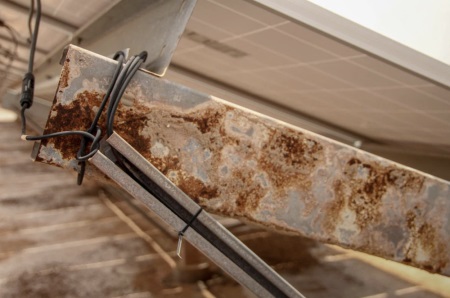
Low-cost solar mounting systems on the market that are priced significantly below market rates commonly suffer from issues such as cutting corners, substandard workmanship, and materials that fail to meet specifications. While they may seem to save costs in the short term, they can lead to multiple long-term hazards—including deformation, rust, leaks, and structural collapse—that far exceed the initial savings. This article highlights the five most critical engineering hazards associated with low-cost solar mounting systems.
I. Insufficient Profile Wall Thickness and Severely Inadequate Structural Load-Bearing Capacity
Genuine photovoltaic mounting systems use profile wall thicknesses that meet the positive tolerance requirements of national standards to ensure structural rigidity. Low-cost mounting systems, however, commonly use non-standard thin-walled profiles or recycled scrap materials to reduce costs by decreasing wall thickness. Such systems have low hardness, poor toughness, and substandard load-bearing capacity, making them unable to withstand strong winds or snow loads. Over the long term, this can lead to beam bending, post deformation, and array collapse. In areas with high wind pressure, it can even result in mounting system fractures and module detachment, directly causing damage to power plant equipment and rooftops.
II. Substandard Anti-Corrosion Processes Lead to Widespread Rusting in the Short Term
Outdoor solar mounting systems must withstand erosion from UV rays, rain, salt and alkali, and temperature fluctuations; the anti-corrosion process determines their 25-year service life. Most low-cost mounting systems rely on half-hearted treatments such as cold galvanizing, simple spray painting, or thin zinc coatings, resulting in zinc layer thicknesses that fall far short of standards. Within 1–2 years of use, symptoms such as whitening, zinc flaking, and rust peeling will appear. The corrosion will continue to erode the base material of the profiles, causing the strength of the mounting system to decline sharply year by year, resulting in rusted-seized bolts and corroded, loose bases, which significantly shortens the overall service life of the power plant.
III. Non-standard and Substandard Components Result in a Loose and Unstable System
In a qualified photovoltaic mounting system, the profiles, clamps, bolts, washers, and base components are all manufactured to uniform standards and have matching specifications. To cut costs, low-cost mounting systems use non-standard, thin clamps, ordinary iron bolts, and substandard washers, resulting in extremely poor compatibility between the components and the profiles. Under prolonged exposure to outdoor vibrations and wind loads, bolts are highly prone to stripping, clamps to loosening, and washers to aging and failure. This can cause PV modules to shift, warp, or become suspended, leading to hidden cracks in the solar cells, a decline in power output, and even the risk of modules detaching and falling.
IV. Lack of Structural Analysis; Fails to Meet Wind and Snow Load Standards
Standard mounting brackets undergo wind tunnel simulations and load calculations before leaving the factory to ensure compliance with wind and snow load standards for different regions. Brackets from low-cost, small manufacturers lack any structural design and are mass-produced using generic molds without consideration for regional conditions. When used in coastal typhoon-prone areas, northern regions with heavy snowfall, or on high-rise rooftops in open fields, they are highly prone to issues such as overall array sway, bracket overturning, and load overload. They are completely incapable of withstanding extreme weather conditions and pose significant safety hazards.
V. Poor Adaptability, Leading to Roof Leaks and Power Generation Losses
Low-cost mounting systems are poorly crafted, have significant dimensional deviations, and lack standardized designs for leveling, ventilation, and waterproofing. After installation, modules are prone to uneven alignment and uneven stress distribution across the panel surface. This not only risks compressing the modules—leading to hidden cracks and hot spots—but also disrupts the ventilation gaps beneath the panels and impedes drainage, resulting in roof water accumulation, mold growth and damage to the waterproofing layer, and roof leaks. Additionally, insufficient panel surface flatness affects the angle of sunlight incidence, causing sustained power generation degradation and significantly reducing long-term power generation revenue.
FAQ:
Q1: How many years will low-cost solar mounting systems last?
Under normal operating conditions, non-standard, low-cost mounting systems will last only 3–5 years before developing widespread rust, deformation, and loosening. They cannot match the 25-year service life of solar modules and will require frequent maintenance and replacement later on, resulting in total costs far higher than those of mounting systems that meet national standards.
Q2: Will slight deformation of the mounting system affect power generation?
Yes. Deformation of the mounting system leads to uneven stress distribution on the solar modules, panel warping, and misalignment of the array tilt angles. This not only causes microcracks in the solar cells and hot-spot failures but also reduces light absorption efficiency, directly resulting in a year-on-year decline in power generation. Additionally, there is a safety risk of modules detaching.
Add : 606, No. 12, Huasheng Road, Huli District, Xiamen,China
WhatsApp : +86153 9592 2968
E-mail : info@powerack.com



 Română


